

Understanding the role of tastemakers,
collectors, editors, and cultural gatekeepers.
Luxury brands are trained to identify their best clients by spend.
The top client is the one with the highest annual purchase value. The most important segment is the VIC. The most valuable customer is the one who buys across categories, attends private previews, receives early access, and maintains a relationship with the maison over many years.
That logic is not wrong. But it is incomplete. Because in luxury, the person who creates demand is not always the person who converts it.
Some of the most important people in the luxury ecosystem may never appear in a CRM dashboard. They may not be top spenders. They may not buy the bag, the watch, the couture look, or the high jewelry piece. They may not even be the commercial target.
But they decide what becomes desirable.
They are the editors who frame a collection before the market understands it. The stylists who place a piece on the right person at the right moment. The collectors who turn objects into cultural artifacts. The curators who give fashion intellectual legitimacy. The artists who transfer symbolic capital to a brand. The concept-store buyers who make a product feel discovered rather than distributed. The cultural insiders whose approval travels quietly through rooms before it becomes visible online.
Luxury has always depended on these people. But their importance is becoming more urgent now because the luxury market is no longer expanding on autopilot.
Bain & Company and Fondazione Altagamma report that the global active luxury client base continued to contract in 2025, with around 20 million consumers exiting the market and active buyers falling to roughly 330 million, down from 400 million in 2022. At the same time, top customers - those spending more than EUR20,000 a year on personal luxury goods - now account for a little more than 46% of total luxury-goods spending, up from 30% in 2019.1
That creates a strategic tension.
Luxury brands need to protect their highest-spending clients. But they also need to regenerate cultural desire among people who may not be buying now, may not be buying often, or may never buy at all - but whose taste shapes the people who eventually do.
The next luxury client strategy cannot be built only around the buyer.
It must also be built around the validator. Desire is not created at the point of purchase
Luxury purchase decisions rarely begin with a product page, boutique visit, or sales appointment. They begin much earlier, in the world of interpretation.
Someone sees a piece on a person whose taste they trust. Someone reads an editor's review. Someone notices that a particular archive silhouette is being referenced by stylists. Someone sees a collector treat a handbag as an object of design history rather than a seasonal accessory. Someone hears that a designer's work matters from people who are not paid to say it.
That is where luxury demand begins: not in transaction, but in translation.
This is not a new idea. The classic communication theory of two-step flow argued that mass media does not simply influence people directly; messages are often interpreted and diffused through opinion leaders first. Elihu Katz's 1957 paper described the hypothesis that ideas often move from media to opinion leaders, and from those leaders to wider publics.2
Luxury works in a similar way. A brand may speak, but tastemakers make it legible.
A runway show is not influential simply because it happens. It becomes influential when the right people interpret it, contextualize it, defend it, critique it, archive it, wear it, reference it, and place it inside a broader cultural conversation.
In mass categories, visibility can drive demand quickly. In luxury, visibility without validation often creates noise. The consumer does not only ask, 'Do I like this?' They ask, 'Does this matter?' 'Who understands it?' 'What does it signal?' 'Will it still feel important later?'
Those questions are answered by cultural intermediaries.
THE HIDDEN ECONOMY OF TASTE
Cultural intermediaries are the people who sit between production and consumption. They do not merely promote products. They qualify them. They decide which objects deserve attention, which codes are meaningful, which aesthetics feel current, and which brands have cultural authority.
Jennifer Smith Maguire and Julian Matthews define cultural intermediaries as tastemakers who help determine what counts as good taste and cool culture in the marketplace. Their role is not passive. They construct legitimacy and add value by shaping how goods are understood.3
That is why luxury cannot reduce influence to audience size.
A celebrity can create visibility. A creator can generate engagement. But a tastemaker creates permission.
Permission to desire something difficult.
Permission to revisit something old.
Permission to believe a brand is becoming interesting again.
Permission to see a product as culturally meaningful rather than commercially pushed.
This is especially important when luxury products are expensive, symbolic, and socially visible. A consumer may admire a campaign, but still hesitate to buy if the product has not been validated by the right cultural context. In luxury, the fear is not only wasting money. It is misreading taste.
The gatekeeper reduces that risk.
Editors, stylists, collectors, curators, and advisors help consumers understand why something matters. They create the confidence around desire. In that sense, they are not outside the luxury sales process. They are upstream of it.
EDITORS DO NOT JUST REPORT LUXURY. THEY PRODUCE LUXURY MEANING.
The editor's role has changed, but it has not disappeared.
In the past, fashion editors controlled a narrower set of powerful cultural channels: magazines, reviews, cover stories, shoots, runway coverage, and seasonal trend reports. Today, authority is more fragmented. Social media, creators, celebrities, newsletters, Discord groups, Substacks, resale platforms, TikTok commentary, AI search, and peer forums all play a role in discovery.
But fragmentation has not eliminated editorial authority. It has made credible interpretation more valuable.
Vogue Business's 2026 How to Sell Now research found that magazine and newspaper articles were the single source luxury consumers relied on most to discover new products and brands, selected by 42% of surveyed luxury consumers. E-commerce sites followed at 39%, social media at 37%, and fashion shows at 33%. The same research also notes the growing role of social platforms, AI search, and peer forums in product evaluation and purchase journeys.4
That matters because luxury consumers are not simply looking for exposure. They are looking for judgment.
They want someone to tell them what is worth noticing.
This is why editorial credibility remains powerful. The editor does not need to buy the collection to influence demand. Their value lies in selection, framing, comparison, and memory. They know what came before. They understand references. They can distinguish a trend from a shift. They can explain why a brand's new direction is meaningful - or why it is not.
A luxury brand that loses editors may still have traffic. But it loses interpretation.
THE COLLECTOR TURNS PRODUCT INTO OBJECT
Collectors play a different but equally important role.
A buyer purchases. A collector consecrates.
The collector does not simply acquire an object; they place it inside a system of meaning. A vintage bag becomes part of design history. A limited-edition collaboration becomes part of cultural memory. A watch becomes evidence of taste, connoisseurship, scarcity, and time. A couture piece becomes less like clothing and more like an artifact.
This is why collectors matter even when they are not buying from the brand today. Their behavior shapes the future value of the brand's past.
When collectors care about a maison's archive, the brand gains depth. When resale communities track certain pieces, the brand gains mythology. When cultural insiders discuss old campaigns, discontinued designs, rare collaborations, or forgotten creative-director eras, they extend the brand beyond the current season.
Art-world collecting shows how powerful this logic has become. The Art Basel and UBS Survey of Global Collecting 2025 examined the behavior and motivations of 3,100 high-net-worth individuals across 10 markets, with high participation from Gen Z and Millennial respondents. Art Basel notes that the study focuses on how younger collectors and women are reshaping collecting behavior in a market increasingly shaped by digital access and social awareness.5
Luxury should pay attention to this because fashion, jewelry, watches, design, art, and collectible culture are becoming more closely connected. The most desirable luxury objects are increasingly evaluated not only as products, but as cultural assets.
Collectors understand this before ordinary consumers do.
They know that the value of an object is not only in its materials. It is in its provenance, rarity, authorship, condition, story, and future interpretability. They teach the market how to look.
In that sense, the collector is not just a client. The collector is an archivist of desire.
CURATORS AND ARTISTS LEND LEGITIMACY THAT ADVERTISING CANNOT BUY
Luxury brands often collaborate with artists, sponsor exhibitions, build foundations, support museums, commission installations, or stage cultural programs. Done poorly, these gestures look decorative. Done well, they allow a brand to participate in culture beyond commerce.
The reason is simple: art can give luxury what marketing cannot always produce - legitimacy.
A campaign can create attention. A cultural institution can create seriousness. An artist can create tension, complexity, and symbolic charge. A curator can place a brand inside a wider history of aesthetics, craft, material culture, identity, or modern life.
This does not mean luxury brands should pretend to be museums. It means they should understand why cultural validation matters.
A 2025 Sotheby's Institute of Art discussion argued that luxury brands, through collaborations and sponsorships with art institutions and artists, have increasingly positioned themselves as cultural agencies. This reflects a broader shift in which luxury is not merely selling goods, but producing cultural environments around those goods.6
That distinction is crucial.
A product can be marketed into awareness. But it must be culturally situated to become meaningful over time.
Artists and curators often do not function as buyers in the traditional luxury-client sense. Their influence comes from association, interpretation, and symbolic transfer. When a respected artist collaborates with a maison, they can lend a product conceptual depth. When a curator frames a brand's archive, they can transform commercial history into cultural history.
For luxury brands, that is not a side activity.
It is a form of long-term brand equity.
The front row is not a customer segment. It is a signaling system.
Fashion week makes the non-buying client visible.
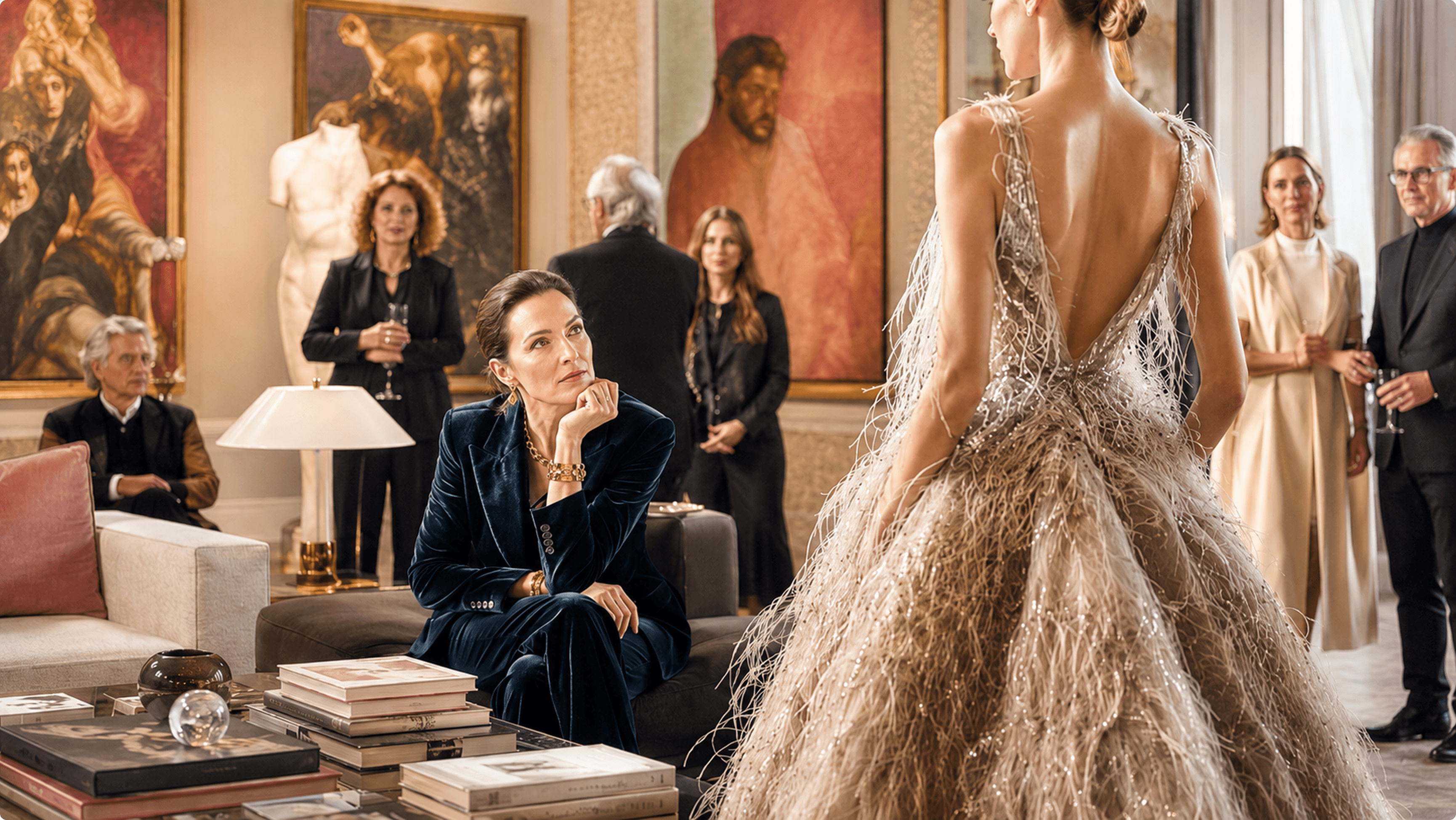
The front row is often discussed as spectacle: celebrities, influencers, editors, stylists, friends of the house, artists, athletes, musicians, clients, and cultural figures arranged into a carefully photographed hierarchy.
But the front row is more than attendance.
It is a live map of who the brand wants to be seen through.
Launchmetrics data reported by Vogue Business for the Spring/Summer 2025 Paris Fashion Week season showed how influence around shows is increasingly shaped by global cultural figures. Paris Fashion Week generated $630 million in Media Impact Value for SS25, while Thai celebrities generated more than 30% of global celebrity-driven MIV. The same report noted that celebrity MIV rose to 18% from 8.6% for SS23, while traditional media also increased its share of impact.7
The point is not only that celebrities matter. The deeper point is that luxury shows now operate as influence ecosystems.
A person seated at a show may not buy the collection. They may never become a high-spending customer. But their presence can reshape who pays attention, which communities engage, how the brand is perceived in different markets, and whether the collection enters cultural conversation.
THE FRONT ROW IS A DISTRIBUTION CHANNEL FOR MEANING.
Every seat says something. Every guest list is a strategy. Every photographed arrival tells the audience who has been invited to interpret the brand.
This is why brands must be careful. A front row built only for reach can feel hollow. A front row built for cultural alignment can make a brand feel alive.
THE CONCEPT-STORE BUYER IS A GATEKEEPER IN DISGUISE
Retail gatekeeping is also changing.
As luxury brands invest more in direct-to-consumer channels, wholesale and multi-brand retail have lost some of their old distribution power. But they have not lost cultural power. In some cases, they have become more important precisely because consumers are overwhelmed by choice.
Vogue Business's 2026 analysis of multi-brand luxury retail found that department stores remained the most common purchase channel among surveyed shoppers, selected by 59% of respondents for luxury purchases in the previous six months. But the more important insight was qualitative: consumers increasingly expect multi-brand environments to offer tighter edits, cultural relevance, exclusivity, and a clear point of view. The report concludes that multi-brand retail is being redefined around influence over scale.8
This is a powerful lesson for luxury brands.
A retailer that curates well does more than sell inventory. It tells the market what belongs together. It introduces emerging designers to established clients. It makes niche brands feel credible. It gives consumers a way to compare, discover, and validate their own taste.
In this sense, the best retailers behave like editors.
They do not simply ask, 'What will sell?'
They ask, 'What should this client understand now?'
That kind of curation can create demand before the consumer knows they want something.
INFLUENCE IS NOT ALWAYS LOUD
One of the biggest mistakes luxury brands make is confusing influence with volume.
The most culturally important person in the room may not have the largest audience. They may not post often. They may not produce obvious metrics. They may not drive immediate conversion. Their influence may move through private conversations, styling decisions, collecting habits, editorial judgment, client introductions, or community trust.
This matters because luxury desire is often formed in semi-private spaces before it becomes publicly visible.
A stylist's pull for a celebrity appearance.
A collector's conversation at a dinner.
An editor's quiet enthusiasm.
A curator's inclusion of a brand in a cultural program.
A boutique advisor's recommendation to a high-value client.
A niche creator's unsponsored product explanation.
A concept-store buyer's decision to carry one piece and not another.
These moments may not look like marketing.
But they are often where luxury meaning is made.
Nielsen's 2021 Trust in Advertising Study found that 88% of global respondents trusted recommendations from people they know more than any other channel.9 Edelman's 2025 Brand Trust research similarly found that 73% of people say their trust in a brand would increase if it authentically reflected today's culture.10
Together, these findings point to the same reality: credibility travels through people, not just platforms.
Luxury brands need paid media. They need campaigns. They need stores, shows, ambassadors, content, and clienteling. But the strongest luxury brands also cultivate the informal networks where taste is formed.
The more fragmented media becomes, the more valuable trusted interpretation becomes.
THE NEW LUXURY INFLUENCE MAP
Luxury brands need to rethink how they define the 'important client.'
The old model prioritizes direct commercial value: spend, frequency, category breadth, and lifetime value. That remains essential. But it should sit alongside another map: cultural influence value.
This map would include people who may not buy often, but who shape desirability.
Editors who produce meaning.
Stylists who create visibility through taste.
Collectors who preserve and elevate archive value.
Curators who connect fashion to culture.
Artists who lend symbolic capital.
Concept-store buyers who validate product through selection.
Creators who explain products with credibility.
Private client advisors who act as trusted gatekeepers.
Community insiders who make a brand feel relevant in specific scenes.
These people should not all be treated like influencers. That is the trap.
A stylist does not need the same relationship as a celebrity ambassador. A collector does not need the same invitation as a VIC. An editor does not need the same brief as a paid creator. A curator does not need the same access as a wholesale buyer.
The point is not to turn every tastemaker into a marketing channel.
The point is to understand the specific kind of authority each person carries.
Some people amplify.
Some people interpret.
Some people authenticate.
Some people archive.
Some people translate between worlds.
Some people make a product commercially desirable because they first make it culturally credible.
THE CLIENT WHO DOES NOT BUY MAY BE THE CLIENT WHO MAKES EVERYONE ELSE WANT TO
Luxury has always sold more than objects.
It sells belief.
Belief that a material is exceptional.
Belief that a house has taste.
Belief that a logo still carries power.
Belief that a design will matter beyond the season.
Belief that a product belongs to a larger story of craft, culture, and identity.
That belief is not created by the brand alone. It is co-authored by the people who interpret the brand for the world.
The mistake is to see non-buying tastemakers as peripheral because they do not immediately convert. In reality, they may sit at the beginning of the demand chain. They are the people who make luxury understandable, desirable, collectible, and socially meaningful.
A customer buys the object.
A tastemaker creates the conditions in which the object becomes worth buying.
For luxury brands navigating slower growth, higher consumer skepticism, fragmented media, and rising pressure to prove cultural relevance, this distinction matters.
The future of luxury client strategy will not only be about who spends the most.
It will be about who shapes desire before the purchase exists.
The most important luxury client may not buy anything.
But without them, no one else knows what to want.
REFERENCES & SOURCES:
- Bain & Company and Fondazione Altagamma, Finding a New Longevity for Luxury, Luxury Goods Worldwide Market Study, 24th edition, 2025, by Claudia D'Arpizio, Federica Levato, Andrea Steiner, Giulia Babbini, Joelle de Montgolfier, and Helene Glaser. Used for the contraction of the luxury client base, the 2025 loss of around 20 million active consumers, the active client base of around 330 million, the increased importance of top customers, and Gen Z's evaluation of brands through cultural relevance rather than status. Available at: https://www.bain.com/insights/finding-a-new-longevity-for-luxury/
- Elihu Katz, The Two-Step Flow of Communication: An Up-To-Date Report on an Hypothesis, Public Opinion Quarterly, Vol. 21, Issue 1, Spring 1957, pp. 61-78. Used for the theory that media influence is often mediated by opinion leaders who interpret and diffuse messages to wider publics. Available at: https://academic.oup.com/poq/article/21/1/61/1886822
- Jennifer Smith Maguire and Julian Matthews, eds., The Cultural Intermediaries Reader, SAGE Publications, 2014. Used for the definition of cultural intermediaries as tastemakers who define good taste and cool culture, and for the role of intermediaries in constructing legitimacy and adding value through the qualification of goods. Available at: https://sk.sagepub.com/book/edvol/the-cultural-intermediaries-reader/toc
- Vogue Business, How to Sell Now research series, 2026, including How to Sell: Product and How to Sell Now: Social and AI. Used for findings on magazine and newspaper articles as discovery sources for luxury consumers, and for analysis of the roles of social platforms, AI search, and peer forums in luxury shopping journeys. Available at: https://www.vogue.com/article/how-to-sell-product
- Art Basel and UBS, The Art Basel and UBS Survey of Global Collecting 2025, authored by Dr. Clare McAndrew of Arts Economics. Used for the survey of 3,100 high-net-worth individuals across 10 markets and for insight into how younger collectors and women are reshaping collecting behavior. Available at: https://www.artbasel.com/stories/the-art-basel-and-ubs-survey-of-global-collecting-2025
- Sotheby's Institute of Art, How Luxury and Art Are Rewriting Industry Boundaries, March 13, 2025. Used for the argument that luxury brands, through collaborations and sponsorships with art institutions and artists, increasingly position themselves as cultural agencies. Available at: https://sothebysinstitute.com/articles/how-luxury-and-art-are-rewriting-industry-boundaries/
- Vogue Business, Filipino and Thai Celebrities Dominated Paris Fashion Week, based on Launchmetrics data for Spring/Summer 2025 Paris Fashion Week. Used for Paris Fashion Week's $630 million in Media Impact Value, the growth of celebrity MIV, the role of traditional media, and the impact of Thai and Filipino celebrities on global fashion-week visibility. Available at: https://www.vogue.com/article/filipino-and-thai-celebrities-dominated-paris-fashion-week
- Vogue Business, How to Sell Now: Multi-Brand, 2026. Used for survey findings on department stores and luxury purchase channels, and for analysis of multi-brand retail's shift from scale-based distribution toward curation, discovery, cultural relevance, editorial authority, and influence. Available at: https://www.vogue.com/article/how-to-sell-now-multi-brand
- Nielsen, Beyond Martech: Building Trust with Consumers and Engaging Where Sentiment Is High, based on Nielsen's 2021 Trust in Advertising Study. Used for the finding that 88% of global respondents trust recommendations from people they know more than any other channel. Available at: https://www.nielsen.com/insights/2021/beyond-martech-building-trust-with-consumers-and-engaging-where-sentiment-is-high/
- Edelman, 2025 Edelman Trust Barometer Special Report: Brand Trust, From We to Me. Used for the finding that 73% of people say their trust in a brand would increase if it authentically reflected today's culture, and for Edelman's argument that brands need to participate in consumers' cultural worlds. Available at: https://www.edelman.com/trust/2025/trust-barometer/special-report-brands